28 July, 2018

Watching the stars 2018

Welcome to the third instalment of Watching the stars, my annual review on the BjP syllabus training DVD distributed for girls and women around Australia to practise in their own homes. This year marks the start of web-streaming so you can view it from a range of devices. However, I do miss the lovely cover printed DVDs as memorabilia. The routines' names were watermarked in the corner which I found very helpful as the video was in one block of about eight minutes. Marching was also a special feature in this resource.

The ladies had two Melissas demonstrating the routines. Melissa R, the winner of the 2017 Open Over 33 section and Ladies Overall Champion performed the beginner-intermediate routine while Melissa D, last year's Elite Champion showcased the Open section. A few of the other girls on the DVD returned to filming after having previously appeared on it. Some have already gathered years of filming experience which I assume is quite different to a real physie competition - multiple takes, changing leotards, fuller makeup, learning everything in a few months and it's essentially a solo. Well done to all the performers on this year's DVD.

Interclub competitions have just started for the BjP School of Physical Culture and I'm sure other codes of physie are having their's too. With my first competition in a week's time, these final days leading up will be scheduled with several sessions of following the stars. In 'advanced' I feel a little bit awkward with the transference of weight in some transitional steps, but Melissa beautifully executed the routine with connection and smoothness throughout. Let's see if I can get the awkwardness out of my routines.


2018 BjP Syllabus DVD Performers

If you've enjoyed this blog post, you may also like:
Watching the stars 2017
Watching the stars 2016


14 June, 2018

My lesson journal: May/June

My recent physie sessions have been filled with innovative, memorable and effective approaches, so I'd like to share some of them with you.

We held beanbags in each hand to feel the 'swing'. The slight weight at the end of our arms enabled for the ebb and flow desired in the swinging routine. Afterwards without the beanbags, we were still able to mimic the heaviness.

Top stands were mastered against a wall to ensure that our back, elbows, shoulders and head were in line with each other. We then applied this activity to the lateral bends with top stand in the 'exercises' routine.

Learning from our peers is one of the most effective ways of realising what works and what doesn't. We partnered up and one lady observed while the other danced. After observing our partner, we gave them some constructive feedback on style and positions.

Different songs with slower tempos were utilised in order for us to deliberately execute positions in warm up. Due to this, we were not able to rely on lyrics/word painting or listening to musical cues.

Earlier this week, I attended my last class before our annual practice competition. The practice competition is a non-competitive event where we dance with our peers and get to watch girls and ladies from all the different age groups present their work. I'm looking forward using my physie smile and remembering all the steps this weekend.


It's getting closer to competition season, here are some stories you may like:


06 May, 2018

My lesson journal: April 2018

Last week was my twelfth lesson of the year! Where did all that time go? I have a feeling that it's going to be time to perform these routines very soon.

Lesson journal 30/04/2018

As always, our teacher likes to start the class with marching. Then we then ran through all our routines although we were still missing some moves from 'advanced'.

I know all the steps of the warm-up routine but the transition between the 16-count sequences is still unfamiliar and awkward to me compared to the choreography of the last two years' routines. With exercises, I think that its repetitive nature and regimented positions make it the easiest to learn. Floordrill is also very positions-based but the view from the floor obstructs peripheral vision. Swing and advanced are least familiar to me and sometimes the moves get blurred between the two because of both their swinging, flowing and free-moving nature.

We learnt the remainder of the choreography for advanced. Again, I am having trouble with remembering swing and advanced at home. I can remember small parts but can't remember preceding and subsequent moves.

Then we worked on the techniques of turn-out and lateral bends. My teacher's innovation was to have two dots on her inner thighs near the knee. Laying on the ground, she showed the class how the dots were revealed when the whole of the hips and legs were correctly turned-out. In pairs, we worked on our position of the week the 'lateral bend' checking that our partner's hips were still and their back not caving in.


For more tips and exercises on goal setting, progress tracking, learning routines and inspiration, check out the self-improvement blog series. 

03 April, 2018

Learning routines

By June or July the whole set of routines will be learnt. While not necessarily memorised or polished, many clubs opt to hold a lollipop/chocolate competition for members to showcase their new moves.

It's April and we're still in the learning phase of the physie season, here are my top tips:

1. Counts of 16. Learn each set of 16 solidly, then join each section up. Use the last few counts of one set to segue into the next, for example [previous set] 13, 14, 15, 16 [current set] 1-16. I think of this as a 'jigsaw puzzle' piece as the ends join together to form a seamless picture.

2. Count out loud - just like how your teacher does in class. Do you find yourself counting in your head or perhaps hearing your teacher's voice?

3 . Repetition or Opposites
Repetition can occur identically - facing the same way, maybe even the melody is the same. Repetition can also alter factors like direction, music (the part of the song) and transitional/ending pose. For the opposite/mirror image, instead of right/left think front/back. This makes it easier when repeating on opposite sides.

4. Just watching and not doing it at the same time. You might pick up on a detail from your teacher/DVD performer. 

5. Word painting - build a story with movement through the music and lyrics. Add some dramatic meaning with facial expressions and gestures. Your nuances make your style unique. 

6. Go with what your body knows - maybe this sequence is a popular one (eg. the grapevine) or the next move comes naturally without deliberately thinking of which foot steps next. 

7. Visually - I have drawn stick figures to remind myself of the moves corresponding to each count. Maybe you're lucky enough to catch a glimpse of the written syllabus.

8. Resources - Most associations provide their members with training resources such as DVDs and CDs. I'm already practising with BjP's practice music download. It's been very helpful between classes for triggering my memory. 


For more tips and exercises on goal setting, progress tracking, learning routines and inspiration, check out the self-improvement blog series.

10 March, 2018

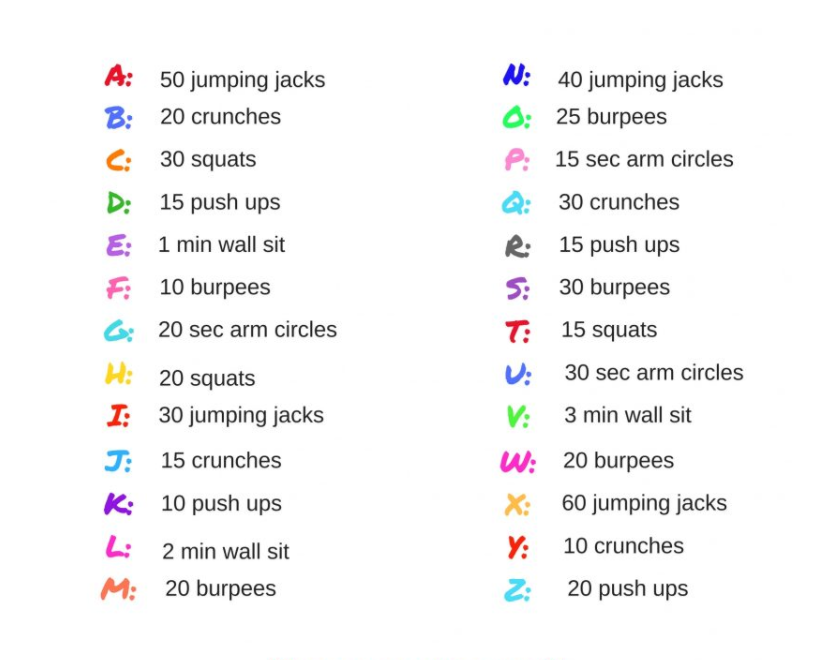
Spell it out: BjP's newest challenge

Physie girls and ladies from the Bjelke-Petersen School of Physical Culture may have seen the latest workout challenge. Basically, you spell your name/club and each letter has a corresponding task. It takes about 2 minutes of preparation time to write the letters and their corresponding 'challenge', then you are ready to exercise.  

Last Sunday, I spelt my name out. I endured:
  • 80 squats 
  • 50 jumping jacks (star jumps)
  • at least 3 minutes of wall sit 
  • & a few more challenges
On Wednesday, I spelt "physical":
  • 80 star jumps
  • 30 burpees 
  • 10 crunches 
  • arm circles, squats, wall sit
Yesterday, I spelt "culture":
  • 3 minutes of wall sit
  • 15 push-ups
  • squats (inevitably) 
  • arm circles
All these challenges took me no longer than 20 minutes, but ensure you are adequately warmed up beforehand. I found that the arm circles helped my shoulder flexibility and was part of the 'swing' routine. Many of the challenges also improved my core strength. I'm going to continue this week with the same sets of exercises and then adding an extra day by spelling my club's name.

Other blog posts you may enjoy: Tracking your progress | Practice makes progress | SMART goals

28 February, 2018

My lesson journal: February 2018

It's the end of February and my classes have already been back for a month! Today, I'll share with you what I've learnt in this week's lesson.

26/02/18

Marching
- put band on left ankle, this is the leading foot
- brushing the foot from the ball until the toes flick up to point
- left foot on the down/heavy/prominent beat of music

Warm-up routine
- revised
- added a few extra steps
- isolated the arm movements from the leg movements
- then put together arms/legs

Advanced routine
- learnt the first few counts

Floordrill routine
- we were shown a couple of additional moves
- learnt from peripheral vision as mostly lying down

Exercises routine
- routine uses a lot of mirroring on reverse side
- revised a few times, but didn't learn new counts as lesson was nearly over

Skills learnt:
- multitasking, learning arms/legs/together
- flexibility
- core strength (especially the 'crunch' in floordrill)

To do before my next lesson:
- Visualise: draw a series of stick figures to remind myself of some of the routines.
- Practise the routines that I can remember and won't mislearn eg. exercises.
- Work on interchangeable skills eg. positions, turnout, facial expression
- Train my abdominal muscles - crunches will help me in floordrill.


For more tips and exercises on goal setting, progress tracking, learning routines and inspiration, check out the self-improvement blog series.