Showing posts with label progress. Show all posts

21 March, 2026

Cross‑training: Skills I’ve learnt to complement physie and vice versa

One of the things I love most about physie is how inclusive it is. People (girls and women in most physie codes) of all ages and abilities can step into a class and feel welcomed. Not every dance style offers that same sustainability which is why I decided to explore other styles in (and a bit before) my physie hiatus. Cross-training has also helped my confidence with attempting "seniors". Each practice offers technical, physical and artistic differences to complement each other. 

✨ Jazz
Keeping up with the high‑paced teens was overwhelming at first. I’m not a huge fan of the rapid rolling around on the floor or multiple jazz turns. (With that being said, I loved the controlled positions in what used to be called “floor drill" in BjP.) Jazz helped my mental sharpness.

๐Ÿ‘  Cabaret Heels
High kicks and pirouettes instantly got harder when you add heels. Weight distribution becomes a whole new puzzle. But I’ll admit there were moments I felt like a Rockette. 

๐ŸŽช Circus Flow Arts (Hula Hooping, Fire, etc.)
These styles teach flair, calmness under pressure and improvisation. You learn to read the audience, adapt on the spot, and keep moving even when something doesn’t go to plan. 

๐ŸŽถ Tap
It's percussion on your feet. I absolutely adore tap. I started with YouTube basics, joined a tweens class, and now I’m in an adult class. I find it very methodical with forward planning of where and when weight needs to be placed. After you gain muscle memory, calculated steps flow into artistry. The only frustration is when your brain knows the step but your feet refuse to cooperate. 

๐Ÿง˜ Yoga & ๐Ÿฉฐ Ballet
In my opinion, these two overlap with physie the most eg. clean lines, balance, posture. - Warrior 2 is looking great thanks to physie. - Warrior 3/aeroplane is still humbling, but I’m glad I get to practise it. - Mirrors in yoga and ballet are a bonus since physie classes don’t always have them. - Ballet elements like relevรฉs, pirouettes, and expression translate directly into physie strength and elegance. 

๐Ÿ’ƒ Zumba
At first it feels chaotic, but once you learn the core steps, they repeat across routines. Instructors use non‑verbal cues to cross language barriers, which is fascinating. Zumba is about volume since it's cardio heavy and continuous, but doesn't focus on positions, rather dancers can do what they're capable of bigger, dramatic or smaller actions don't matter. 

๐ŸŽก Aerial Arts
Dancing in the air while manipulating an apparatus challenges strength, coordination, flexibility and proprioception. Being adaptable is a must since you might not spin exactly the same each time, grip gets affected by weather and you might even need to perform on the venue's gear that you've never practised on.

06 June, 2020

Getting better at physie during isolation

It has been a while since I wrote my article for the self-improvement blog series, so I thought I'd share some activities I've been doing during isolation to improve physie. I have been doing a bit of cross training in similar disciplines to boost my overall fitness and flexibility. There are so many great video resources by inspiring and qualified teachers. 

Physie: Watch the training videos and other resources from your association and club. Have a look at other girls/ladies outside of your age/category and learn something from them. Are there extra resources/online sessions delivered by your club or association? If so, why not join in?

Ballet: Pointed toes, balancing, lengthening limbs and control are transferable skills to physie. 

Pilates: Core strength and control can help with balances and floor exercises. 

Yoga: Mental wellbeing, breathing, strength and flexibility can help you become a well-rounded physie girl/lady. 

Check out my other self-improvement blogs here.

26 April, 2020

Physie online/ April 2020 lesson journal

Our classes have moved to an online platform where members can share and upload progress videos and asking teachers/group members for feedback. Just last week, the club launched live lessons so that we get the motivation to dance at our normal times and learn routines as if we were at class.

A benefit of the online platform is that we get access to the tutorials throughout the week which might help learning routines. We can also pause, rewind and slow down the speed of the recordings.

However, a few pitfalls include the lack of social interaction (especially our prolonged drink breaks), no peripheral vision, re-watching can get boring, view is sometimes obscured (figuring out the intricacies of each move). Also, I am yet to figure out how to use the online platform to filter tasks I haven't completed.

So far, I have mastered only the warm-up and exercises routines ... Three more to learn.
Thank you to the teachers and volunteers who make remote physie fun!

13 April, 2020

Lesson journal: Feb-Apr 2020

Woah... it's already April.
Let's rewind.

In mid-February, the club started lessons as normal with ladies coming in for their weekly physie lessons. We continued learning our routines with our 2 teachers. I managed to remember the warm-up and exercises routines before in-person lessons ceased.

March came and hand sanitiser acted as an entry token into the hall. Dance schools and gyms were operating as normal till mid-March. Unfortunately, in the space of just hours, these activities were halted. Literally overnight, indoor sports were ordered to shut down.

The physie community was optimistic that competitions will still go ahead later this year with zones but there are no interclubs for the 2020 (July/Aug) season. Head office announced this a few days before leotard orders had to be finalised so that people could pull out of ordering multiple garments.

On the bright side, I have my physie music, online modules with walkthroughs and soon I can look forward to live virtual lessons.
Physie social distancing

17 May, 2019

My lesson journal: May 2019

It's now mid-May and only a month until the practice lollipop competition at my club. We have just begun practising with the new competition music and although it's only a few beats per minute faster, fluency in routines is needed to keep up with the upbeat music.

Marching - revised marching and pointing feet with turnout

Warm-up - complete
Level of confidence - ๐Ÿ˜ƒ I know all the moves and transitions, but will need to add some personality and flair into the performance.

Floordrill - need to figure out a worthy 'get up'
Level of confidence - ๐Ÿ˜ฎ Probably know 3/4 of the moves, the transition moves are the ones I need most work on.

Swing - complete
Level of confidence - ๐Ÿ˜ƒ My favourite routine this year is swing. I cannot solidly perform the second/opposite side yet.

Exercises - complete (the first one finished)
Level of confidence - ๐Ÿ˜Š Confident. I like this one, but I liked last year's song better.

Advanced - the whole routine (vaguely)
Level of confidence - ๐Ÿ˜ฉ In alignment with past 'advanced' routines, the use of word painting is prevalent. There are also a few transferences of weight which can be off-putting when not yet mastered.

I can't wait for the new 2019 syllabus DVD which was recorded last weekend to be released so I can revise with confidence at home.

24 January, 2019

2019! Back to physie challenge - Day 5

Today's the final day of the back to physie challenge and I encourage you to organise, sort and label your physie paraphernalia from previous years.

Organise - Keep all your items together in a display folder or special box/hanger/sash for medals.
Sort - Arrange items based on date in reverse chronological order or sort them into categories such as interclubs, zones, nationals. Keep the program booklets together its competition number and certificate.
Label - On the back of your medals and competition numbers write the date and event so that you can remember where you earnt your medals. Read labelling physie keepsakes for more tips.


23 January, 2019

2019! Back to physie challenge - Day 4

Follow Phoebe Collins, former Grand Champion, in her article about stretching and achieving the splits. While the splits is a staple in junior and senior floordrill routines each year, ladies do not need to perform the splits.
Find the article here.


Answers for day 2 challenge - naming physie positions:
1. Attention
2. Top stand
3. Yard
4. Oblique
5. Flight
6. Reach
7. Trunk forward bend
8. Lunge
9. Drag
10. Lateral bend

22 January, 2019

2019! Back to physie challenge - Day 3

Today's challenge is to march with the 2016 Ladies Grand Finalists.


Marching is the first impression that you present to judges. It demonstrates posture, pointed toes, turn out, musicality and shoulder flexibility. Marches for ladies are consistently around 100 beats per minute. 

Read "March into March" to see how I grasped the concept of marching in physie and turning corners.

21 January, 2019

2019! Back to physie challenge - Day 2

Today's challenge is to revise 10 basic positions of physie.

Execute the positions to the best of your ability with the clues given below. Answers of positions will be released on day 4 of the challenge. I recommend checking alignment and aesthetics in the mirror. Remember your physie smile. :)

Have a look at Physie 101's post for help and visual guidance.

  1. Starts with the letter A, toes turned out, heels together, fingers down
  2. Fingertips touching on the top of your head, elbows out
  3. Starts with Y, arms sideways and parallel to floor
  4. Arms form a V shape upwards, palms up
  5. Palms down, fingertips level with head, straight arms outwards and slightly upwards
  6. Arms stretching forwards, parallel to the floor, palms inwards
  7. Three words, bending torso forwards and parallel to ground
  8. Starts with L, front knee bent and both feet turned out
  9. Works your shoulder flexibility, arms are pulled behind body diagonally downwards
  10. Stretches your lateral muscles, usually done while hands are in 'adoration' or 'top stand

19 January, 2019

2019! Back to physie challenge - Day 1

I am ready to go back for a fresh, new season of physie in 2019.
In this seasonal series, I will be posting challenges every day for the next week to prepare and revise physie essentials.


Sara from Inspired Physiotherapy demonstrates quad exercises to allow physie girls/ladies to straighten their knees especially in floordrill. It's been a while (over three months) since I've consciously done physie so this is a great revision. 


29 August, 2018

Labelling physie keepsakes

By this time of year, you may have already accumulated a few medals, certificates and numbers from competitions. At my club's annual competition, we have a march-past where we wear our sashes accessorised with our colourful medals. With similar-looking badges from year to year, it can be hard to pinpoint the exact competition when it was earnt. This is why I label my keepsakes. This is also a good measure to prevent lost badges. In the case that it gets unlatched, you will be able to identify your handwriting.

Medal:
  • Date
  • Interclub host/ type of competition
Number:
  • Date/day
  • Interclub host/ type of competition
  • Placing (if applicable)
  • Age group/ category
    At the moment, I don't label my category but I keep the program booklets to follow what level I'm in.
I keep my certificates, numbers and programs in a display folder. The medals with lanyards are hung up on a bookshelf until it is time to attach them to my sash.

Labelling the back of my number and medal.

14 June, 2018

My lesson journal: May/June

My recent physie sessions have been filled with innovative, memorable and effective approaches, so I'd like to share some of them with you.

We held beanbags in each hand to feel the 'swing'. The slight weight at the end of our arms enabled for the ebb and flow desired in the swinging routine. Afterwards without the beanbags, we were still able to mimic the heaviness.

Top stands were mastered against a wall to ensure that our back, elbows, shoulders and head were in line with each other. We then applied this activity to the lateral bends with top stand in the 'exercises' routine.

Learning from our peers is one of the most effective ways of realising what works and what doesn't. We partnered up and one lady observed while the other danced. After observing our partner, we gave them some constructive feedback on style and positions.

Different songs with slower tempos were utilised in order for us to deliberately execute positions in warm up. Due to this, we were not able to rely on lyrics/word painting or listening to musical cues.

Earlier this week, I attended my last class before our annual practice competition. The practice competition is a non-competitive event where we dance with our peers and get to watch girls and ladies from all the different age groups present their work. I'm looking forward using my physie smile and remembering all the steps this weekend.


It's getting closer to competition season, here are some stories you may like:


03 April, 2018

Learning routines

By June or July the whole set of routines will be learnt. While not necessarily memorised or polished, many clubs opt to hold a lollipop/chocolate competition for members to showcase their new moves.

It's April and we're still in the learning phase of the physie season, here are my top tips:

1. Counts of 16. Learn each set of 16 solidly, then join each section up. Use the last few counts of one set to segue into the next, for example [previous set] 13, 14, 15, 16 [current set] 1-16. I think of this as a 'jigsaw puzzle' piece as the ends join together to form a seamless picture.

2. Count out loud - just like how your teacher does in class. Do you find yourself counting in your head or perhaps hearing your teacher's voice?

3 . Repetition or Opposites
Repetition can occur identically - facing the same way, maybe even the melody is the same. Repetition can also alter factors like direction, music (the part of the song) and transitional/ending pose. For the opposite/mirror image, instead of right/left think front/back. This makes it easier when repeating on opposite sides.

4. Just watching and not doing it at the same time. You might pick up on a detail from your teacher/DVD performer. 

5. Word painting - build a story with movement through the music and lyrics. Add some dramatic meaning with facial expressions and gestures. Your nuances make your style unique. 

6. Go with what your body knows - maybe this sequence is a popular one (eg. the grapevine) or the next move comes naturally without deliberately thinking of which foot steps next. 

7. Visually - I have drawn stick figures to remind myself of the moves corresponding to each count. Maybe you're lucky enough to catch a glimpse of the written syllabus.

8. Resources - Most associations provide their members with training resources such as DVDs and CDs. I'm already practising with BjP's practice music download. It's been very helpful between classes for triggering my memory. 


For more tips and exercises on goal setting, progress tracking, learning routines and inspiration, check out the self-improvement blog series.

10 March, 2018

Spell it out: BjP's newest challenge

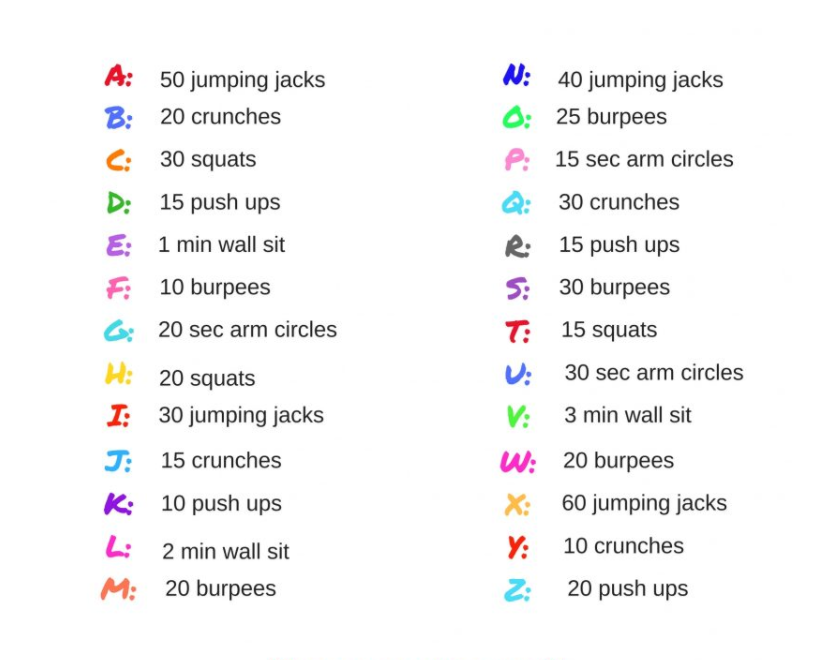
Physie girls and ladies from the Bjelke-Petersen School of Physical Culture may have seen the latest workout challenge. Basically, you spell your name/club and each letter has a corresponding task. It takes about 2 minutes of preparation time to write the letters and their corresponding 'challenge', then you are ready to exercise.  

Last Sunday, I spelt my name out. I endured:
  • 80 squats 
  • 50 jumping jacks (star jumps)
  • at least 3 minutes of wall sit 
  • & a few more challenges
On Wednesday, I spelt "physical":
  • 80 star jumps
  • 30 burpees 
  • 10 crunches 
  • arm circles, squats, wall sit
Yesterday, I spelt "culture":
  • 3 minutes of wall sit
  • 15 push-ups
  • squats (inevitably) 
  • arm circles
All these challenges took me no longer than 20 minutes, but ensure you are adequately warmed up beforehand. I found that the arm circles helped my shoulder flexibility and was part of the 'swing' routine. Many of the challenges also improved my core strength. I'm going to continue this week with the same sets of exercises and then adding an extra day by spelling my club's name.

Other blog posts you may enjoy: Tracking your progress | Practice makes progress | SMART goals

12 January, 2018

Years from now: Goal setting

Having a goal journal means seeing your ambitions listed in black and white. Goal setting is a tool for life!

The physie year is starting soon so it's a great time to write out your goals for 2018 and beyond. Goals that are closer to now should follow the SMART principle which I've written about here in an older post. Also, check out my other posts from the self-improvement blog series.

Long-term goals (5 years and beyond)
I hope I'll maintain my strength, flexibility and stamina ... (and fit in my current leotard).

Mid-term goals (1-5 years)
Achieve seniors (possibly join a class and compete). For non-physie readers, 'seniors' is the syllabus for young ladies. It is more fast paced than the ladies and junior syllabi.

Short-term goals (this year)

  • Try learning from DVD
  • Hold planks, splits, balances, back bend/impulse
  • Learn moves such as fan kicks, half pirouettes and leaps
  • Do the best I can with the current ladies syllabus

This month's goals (will ultimately contribute to short/mid/long term goals)

  • Continue to stretch achieving both splits
  • Increase the time held for balances/planks by a few seconds each month

Let's apply my mid-term goal to the SMART principle:

Specific - Learn a complete seniors' syllabus.
Measurable - When I finish learning, memorise and execute the moves.
Achievable - Yes, I will work very hard.
Realistic - Should be, I'm progressing.
Timely - In a year or two.

It's simple to start your own journal or list of goals. If you already list your goals, good on you, or if you don't, why not start now?

15 August, 2017

Practise performing

It is important to practise performing in low-stress situations such as practice competitions run by your club (affectionately known as lollipop/chocolate competitions) where you have the opportunity to perform in a familiar environment and with people you know. There are noticeable differences between dancing in lessons, at mock competitions, interclubs, zone and intra-club competitions. I once read that clubs cannot use their normal class venues to host an interclub. This provides a level playing field for all physie girls and ladies as competitors will not have had a chance to regularly dance at the venue. However, girls/ladies may have danced at the venue before for a biennial interclub or participate in other fitness activities at the chosen venue.

What's the difference between class and competition?

  • time of day
  • audience
  • dancing with others (not from your own club) can be off-putting when they perform moves at a slower/faster pace
  • expectations
  • grooming
  • venue and environment
  • anxiety
  • louder music (I only realised this last week at an interclub)
  • the material of the hall floor (I also only just realised the impact of this on foot grip)
  • harder to access drinking water & bathroom facilities especially when you're in a leotard


How can we create our own opportunities to mimic a performance/competition?

  • wear competition attire to class (leotard, hair)
  • perform in front of family and friends
  • participate in opportunities given by the club (fete performances, showcases)
  • participate in practice competitions
  • enter yourself into a [talent] show (especially for girls in school)


For more tips check out Practice Makes Progress.

22 July, 2017

5 words for 5 routines

Two weeks to go until my first interclub for the year and for me that means only two lessons to go. By now routines are memorised and I do not have to think of what the next count is. With that being said, I still have to make sure that I maintain technique such as posture and pointed toes.

In this self-improvement post, I want to share with you how I will be simplifying my approach, dancing five routines with five memorable words. For several weeks, I asked myself what expression or message I wanted to convey with each routine. Now I have one word to focus on for each routine that will hopefully bring out my best dancing. This simple approach clears your mind so that you can be in the zone to dance. I highly encourage you to try this activity.


21 March, 2017

Tracking your progress

Here I'll share some tips on tracking your progress as part of the self-improvement blog series. Keeping a record of progress can be hard due to the fact that it is difficult to calculate or measure. Some achievements show quantifiable progress while other developments are not quantifiable. For example, you can measure how high you can kick but you cannot measure how well you dance. That raises the question of, "How do I know if I've improved?"

Sometimes it is frustrating to see little improvement on a week-to-week basis. So here's advice that can help you improve in the long run.

  • Remind yourself of the bigger picture, the physie year is around 40 weeks.
  • If you are relatively new to physie, look back at how far you've come in a short period of time.
  • Listen to praise and feedback from your teacher and peers. Believe it when they tell you that you're doing well (seriously you are) and trust that they will guide your further progress.
  • Video yourself so that you can be your own audience and critic (but don't be too harsh on yourself). At the end of the year video yourself again and see the difference.
  • Practice diary - Write your thoughts, questions, goals and achievements ... I can now touch my toes ... Tonight I learnt the last 16 counts of swing ... You can even doodle/sketch your routine.

Start now! Competition season is just around the corner.