Last week was my twelfth lesson of the year! Where did all that time go? I have a feeling that it's going to be time to perform these routines very soon.
Lesson journal 30/04/2018
As always, our teacher likes to start the class with marching. Then we then ran through all our routines although we were still missing some moves from 'advanced'.
I know all the steps of the warm-up routine but the transition between the 16-count sequences is still unfamiliar and awkward to me compared to the choreography of the last two years' routines. With exercises, I think that its repetitive nature and regimented positions make it the easiest to learn. Floordrill is also very positions-based but the view from the floor obstructs peripheral vision. Swing and advanced are least familiar to me and sometimes the moves get blurred between the two because of both their swinging, flowing and free-moving nature.
We learnt the remainder of the choreography for advanced. Again, I am having trouble with remembering swing and advanced at home. I can remember small parts but can't remember preceding and subsequent moves.
Then we worked on the techniques of turn-out and lateral bends. My teacher's innovation was to have two dots on her inner thighs near the knee. Laying on the ground, she showed the class how the dots were revealed when the whole of the hips and legs were correctly turned-out. In pairs, we worked on our position of the week the 'lateral bend' checking that our partner's hips were still and their back not caving in.
For more tips and exercises on goal setting, progress tracking, learning routines and inspiration, check out the self-improvement blog series.
06 May, 2018

03 April, 2018
Learning routines
By June or July the whole set of routines will be learnt. While not necessarily memorised or polished, many clubs opt to hold a lollipop/chocolate competition for members to showcase their new moves.
It's April and we're still in the learning phase of the physie season, here are my top tips:
1. Counts of 16. Learn each set of 16 solidly, then join each section up. Use the last few counts of one set to segue into the next, for example [previous set] 13, 14, 15, 16 [current set] 1-16. I think of this as a 'jigsaw puzzle' piece as the ends join together to form a seamless picture.
2. Count out loud - just like how your teacher does in class. Do you find yourself counting in your head or perhaps hearing your teacher's voice?
3 . Repetition or Opposites
Repetition can occur identically - facing the same way, maybe even the melody is the same. Repetition can also alter factors like direction, music (the part of the song) and transitional/ending pose. For the opposite/mirror image, instead of right/left think front/back. This makes it easier when repeating on opposite sides.
4. Just watching and not doing it at the same time. You might pick up on a detail from your teacher/DVD performer.
5. Word painting - build a story with movement through the music and lyrics. Add some dramatic meaning with facial expressions and gestures. Your nuances make your style unique.
6. Go with what your body knows - maybe this sequence is a popular one (eg. the grapevine) or the next move comes naturally without deliberately thinking of which foot steps next.
7. Visually - I have drawn stick figures to remind myself of the moves corresponding to each count. Maybe you're lucky enough to catch a glimpse of the written syllabus.
8. Resources - Most associations provide their members with training resources such as DVDs and CDs. I'm already practising with BjP's practice music download. It's been very helpful between classes for triggering my memory.
For more tips and exercises on goal setting, progress tracking, learning routines and inspiration, check out the self-improvement blog series.
10 March, 2018
Spell it out: BjP's newest challenge
Physie girls and ladies from the Bjelke-Petersen School of Physical Culture may have seen the latest workout challenge. Basically, you spell your name/club and each letter has a corresponding task. It takes about 2 minutes of preparation time to write the letters and their corresponding 'challenge', then you are ready to exercise.
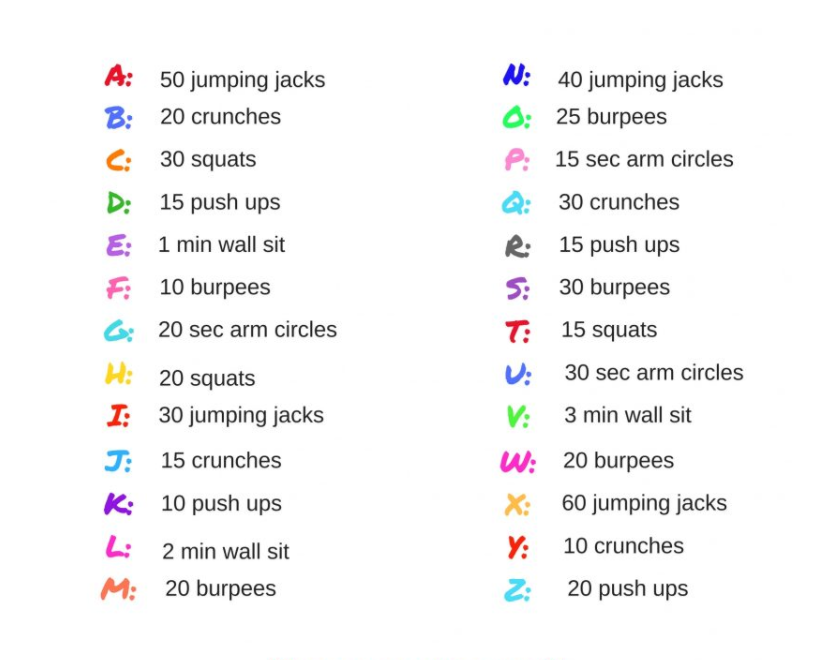
- 80 squats
- 50 jumping jacks (star jumps)
- at least 3 minutes of wall sit
- & a few more challenges
- 80 star jumps
- 30 burpees
- 10 crunches
- arm circles, squats, wall sit
- 3 minutes of wall sit
- 15 push-ups
- squats (inevitably)
- arm circles
Other blog posts you may enjoy: Tracking your progress | Practice makes progress | SMART goals
28 February, 2018
My lesson journal: February 2018
It's the end of February and my classes have already been back for a month! Today, I'll share with you what I've learnt in this week's lesson.
26/02/18
Marching
- put band on left ankle, this is the leading foot
- brushing the foot from the ball until the toes flick up to point
- left foot on the down/heavy/prominent beat of music
Warm-up routine
- revised
- added a few extra steps
- isolated the arm movements from the leg movements
- then put together arms/legs
Advanced routine
- learnt the first few counts
Floordrill routine
- we were shown a couple of additional moves
- learnt from peripheral vision as mostly lying down
Exercises routine
- routine uses a lot of mirroring on reverse side
- revised a few times, but didn't learn new counts as lesson was nearly over
Skills learnt:
- multitasking, learning arms/legs/together
- flexibility
- core strength (especially the 'crunch' in floordrill)
To do before my next lesson:
- Visualise: draw a series of stick figures to remind myself of some of the routines.
- Practise the routines that I can remember and won't mislearn eg. exercises.
- Work on interchangeable skills eg. positions, turnout, facial expression
- Train my abdominal muscles - crunches will help me in floordrill.
For more tips and exercises on goal setting, progress tracking, learning routines and inspiration, check out the self-improvement blog series.
12 January, 2018
Years from now: Goal setting
Having a goal journal means seeing your ambitions listed in black and white. Goal setting is a tool for life!
The physie year is starting soon so it's a great time to write out your goals for 2018 and beyond. Goals that are closer to now should follow the SMART principle which I've written about here in an older post. Also, check out my other posts from the self-improvement blog series.
Long-term goals (5 years and beyond)
I hope I'll maintain my strength, flexibility and stamina ... (and fit in my current leotard).
Mid-term goals (1-5 years)
Achieve seniors (possibly join a class and compete). For non-physie readers, 'seniors' is the syllabus for young ladies. It is more fast paced than the ladies and junior syllabi.
Short-term goals (this year)
This month's goals (will ultimately contribute to short/mid/long term goals)
Let's apply my mid-term goal to the SMART principle:
Specific - Learn a complete seniors' syllabus.
Measurable - When I finish learning, memorise and execute the moves.
Achievable - Yes, I will work very hard.
Realistic - Should be, I'm progressing.
Timely - In a year or two.
It's simple to start your own journal or list of goals. If you already list your goals, good on you, or if you don't, why not start now?
The physie year is starting soon so it's a great time to write out your goals for 2018 and beyond. Goals that are closer to now should follow the SMART principle which I've written about here in an older post. Also, check out my other posts from the self-improvement blog series.
Long-term goals (5 years and beyond)
I hope I'll maintain my strength, flexibility and stamina ... (and fit in my current leotard).
Mid-term goals (1-5 years)
Achieve seniors (possibly join a class and compete). For non-physie readers, 'seniors' is the syllabus for young ladies. It is more fast paced than the ladies and junior syllabi.
Short-term goals (this year)
- Try learning from DVD
- Hold planks, splits, balances, back bend/impulse
- Learn moves such as fan kicks, half pirouettes and leaps
- Do the best I can with the current ladies syllabus
This month's goals (will ultimately contribute to short/mid/long term goals)
- Continue to stretch achieving both splits
- Increase the time held for balances/planks by a few seconds each month
Let's apply my mid-term goal to the SMART principle:
Specific - Learn a complete seniors' syllabus.
Measurable - When I finish learning, memorise and execute the moves.
Achievable - Yes, I will work very hard.
Realistic - Should be, I'm progressing.
Timely - In a year or two.
It's simple to start your own journal or list of goals. If you already list your goals, good on you, or if you don't, why not start now?
23 December, 2017
Physie favourites - melodies for beginning instrumentalists
If you or your child are lucky enough to have an instrument over the holidays, here's some sheet music for four of the melodies featured in this year's junior syllabus.
Merry Christmas and Happy New Year!
Band instruments:
Flute, Oboe
Clarinet, Bass Clarinet, Trumpet
Alto Clarinet
Alto Saxophone
Tenor Saxophone
Horn in F
Trombone, Euphonium, Bassoon
Tuba
Glockenspiel/Mallets
String instruments:
Violin
Viola
Cello
Double Bass
Piano
Recorder
Audio:
Audio: band (wind, brass, mallets)
Audio: strings
Audio: recorder
Audio: piano
Each of the 4 instrument families are only compatible with other instruments in their family i.e. all band instruments play the same sounding notes. However, a band instrument will play different notes to a string instrument.
09 December, 2017

Subscribe to:
Posts (Atom)